
I've been asked by a few subscribers how to play Apple and its 5pm ET earnings release today. Let's get this straight: no one knows for sure what shall happen; it's all a big guess - even for those highly paid Wall Street analysts and the hottest of stock and options traders. So take my opinion for what's it worth - about the same as everyone else's.
Long the stock and ridden the wave of the last few months? I'd just hold and ride it higher for even higher prices this spring. This is going to be volatile once earnings are out but no sense in knee jerk selling. How low could it go to make you lose money? Only you know your loss tolerance. Worried about some sort of big pit in the Apple results? Hedge by buying some near term puts.
Option holder? Take some profits off the table if your position has rewarded you with big gains in recent days. Remember, once the 4 pm bell sounds, you are trapped until 9:30 the next morning. Don't be piggish. Also consider rolling into longer term calls (eg spring strikes) if say a November expiring position is up better than 100% for you.. I know some options traders who do not hold through any earnings. They wait for the numbers to see whether their justification for being long or short is validated by the numbers and then go back in.
New option holder as of today or Friday. heh. good luck. You might as well be shooting dice.No advice, but be prepared to lose it all if you're wrong about direction, or the stock stands still. There is such a thing as evaporating volatility after an event which can put you behind the eight-ball. I will note that the options players are going nuts over the calls today with volume in most strikes exceeding open interest. Better hope it's not a contrary indicator. The buys in Apple November options go all the way to the 470 strike.
By the way, going into GooG earnings many were unsure. In Apple's case, many see an upside explosion coming. Sentiment in the two company's vastly different ahead of earnings.
All of this is not official FA type of advice, just some rambling thoughts.
Monday, October 18, 2010


Sunday, October 17, 2010
Why Is The Wall Street Journal Asleep At the Switch?
From http://www.cjr.org/the_audit/the_journal...
So we’ve got a nationwide scandal in the still-crippled industry that caused the crisis in the first place—a scandal with potentially systemic (meaning crisis-causing) implications. And how has our leading financial newspaper covered it?
Well it hasn’t, really. Not much, anyway.
The Wall Street Journal hasn’t had a single page one piece on the scandal, which is now a couple of weeks old. And the paper has had just one section-front story on it: Wednesday’s good piece in Money & Investing on how mortgage-securities investors are threatened by it.
Not that there’s been much inside coverage, either.
There’s an A3 news story today. There was an inside story yesterday from the Bay Area that touches around the edges of the scandal but, bizarrely, doesn’t even mention it. On Monday there was a decent feature, also on A3. There was a 700-word C5 story a couple of weeks ago, and other than three or four FT-length news stories, that’s it.
Compare that to The New York Times and Washington Post which (especially the Post) have a fraction of the business staff that the Journal has.
The Times has put the story on a section front eight times, including twice on the front page this week.
The Post has done even better. I count four page one stories on the scandal, including an agenda-setting one on September 23, and several other major pieces.
The Journal is getting its clock cleaned on this story. (For that matter, so has the Financial Times, although it has put the story on page one once, and has the excuse of being based in the UK). And not just by biggies like the Times and the Post. Go click the real estate keyword over at Yves Smith’s Naked Capitalism and look how outclassed it has been by a single blogger.
Admittedly, Smith has done yeoman’s work on this story, but she’s one person. It’s time for the Journal to flex its muscles on this one.
Saturday, October 16, 2010
Mortgage modifications - Beware
Banks are up to their usual tricks. They have now turned their sinking mega-ship to suddenly offer mortgage modifications to people they once treated like dirt. There is plenty of anecdotal evidence of a sudden surge in mortgage modification activity. This includes my neighbor who shared more information with me this week about her situation.
Think about it. What better way to circumvent the foreclosure-gate process than to get foreclosure people into a new loan with proper paperwork which would enable a flawless future foreclosure? (Most mods still end up in default). Home debtors under a new modification would effectively reaffirm their debt, the old flawed mortgage would go away and the bank would get a sure way to foreclose problem free. By giving new mods, the bank also releases itself from the potential of having to buy back the old, bad debt. Until now banks have steadfastly refused to do many mods.
Remember, if it sounds too good to be true, it is just that. Beware of bankers bearing what seem to be gifts. If you have received a modification approval in the last few weeks after months of waiting, or even a sudden invitation to apply, get with an attorney -- even if you have to scrape the money together. Know your legal options. This goes especially for foreclosure candidates, but also for people who are paying on time who may suddenly find themselves enticed their bank to do a refi. Demand the note!. More indication of what a mess things really are.
Friday, October 15, 2010
A bankruptcy attorney speaks
No one deserves a free house, but banks must do their deeds within confines of the law.
Thursday, October 14, 2010
Google $Goog
The market has gone gaga for Google once again. The stock roared ahead by over $50 from the day's lows on a surprisingly strong earnings report. Sorry, I didn't play it, or blog it though I did consider it. Who really knew what was going to happen? I guess I am too risk averse to deploy hard won gains into something whose outcome was well shrouded. I avoid investing in big IFs. Yes, some good bullish strategies were outlined on the web, but all were predicated on the gamble of upside surprise - a huge IF prior to the release of the actual numbers.Winners today had lady luck (which is nice) on their side but didn't possess any special foreknowledge or skill. Today's Goggle guessing is leading to riches (super peachy), but one bad guess and it can be curtains. If you missed the Google train today because you follow a certain discipline, there will be other opportunities soon enough - don't get hung up on "shoulda, woulda, coulda".
One little consolation: Goggle will bring in a rising tide tomorrow that will float many other boats, unless Bernanke says something bad.
One little consolation: Goggle will bring in a rising tide tomorrow that will float many other boats, unless Bernanke says something bad.
The coming Ben Speech

Dollar getting creamed
No wonder the dollar index has slid below .77 in a disorderly market tonight. Central Bankers better get a grip on this - IF they can. What? more in effective intervention? Sadly, most will feel a boot on their neck when the system goes into total haywire mode. More dollar printing is a dollar killer. Raising rates is an instant bank killer. What will the Fed do? Amazing things are unfolding.

Wednesday, October 13, 2010
Gold going higher again... silver too.
Metals investors can thank Uncle Ben Bernanke's magic money printing press for another leg up in gold to the $1375 notch today. Silver is knocking on the $24/oz door (won't be long 'till we see $30, at this rate).
Ah, what it must be like to be a counterfeiter with total impunity. That's what Federal Reserve is. Imagine being able to shove some worthless paper instrument into your own mass magic duplicator and out pops crisp $100 dollar bills. Ben's printer will eat anything, especially valueless bank assets, and out pops the monopoly money with pretty pictures of Franklin, Grant, Jackson, etc.
But let's throw in a plot complication. Now, the state attorneys general of all 50 states have snapped on their rubber gloves and are probing the mortgage/foreclosure mess. This virtually assures, as I've been blabbing about, that the foreclosure landscape will undergo a sort of nationwide nuclear winter. Obama and Geithner have both said 'no freeze' needed, but Mr. Freeze is going to have his way through our states. Worse, the questions surrounding proper transfer or mortgages into trusts assure coming mayhem in various mortgage related derivatives markets. It's a mess which the gold and silver market investors sense.
As telegraphed by the latest Fed minutes, add the prospect of more QE (money printing) in a vain attempt by the Fed to keep interest rates at near microscopic levels AND it's no wonder that gold and silver have blasted higher. Do we even want to think of what happens to the dollar's existence if trillions more in Ben bucks are used to save the banksters???? No wonder gold and silver are in TILT mode. What a mess.
To ramble further. These are extremely powerful forces at work. On one side of the ring you've got the Fed/banking cabal and on the other side you've got the metals screaming further dollar devaluation and rising inflation pace. Who will win? I think that metals and commodities will rule the day, but expect both sides to duke it out violently. I don't expect the banks will take all of this lying down. It will be intriguing to see what type band aid the D.c. to NY bunch will attempt to pull out of the box and what type of lies and deceptions will be used. This is only round one.
Two risky trades
At a few minutes before closing bell I bought November 60 CSX calls and Oct 20 Intel calls.
It looks like the CSX play will perform well. The tell was recent strong rail traffic reports. Another feature was the extremely heavy volume in both October and November calls that overwhelmed open interest in certain strikes. This a feature that I seek out in my options scans: volume that swamps open interest. I would be looking at other rails, including Norfolk Southern.
While volume was very heavy in Intel calls, it wasn't of the sort that exceeded open interest. So it was really a "gut" feeling kind of trade based on knowing some of the fundamentals. Call it a gamble. We know all about the "expectations" game on Wall Street. Intel had previously guided lower for the quarter and set up a not so unusual scenario of beating lowered expectations. C'mon, isn't it ridiculous that the bears in the stock reasoned that Intel would destroy the market by missing lowered estimates? Intel's stock is in a multi year dead money downtrend for certain, but its managers are not complete idiots that they would allow it to post a miss. Wall Street is onto the non growth stock ways of Intel and reaction to the numbers was muted. We'll see how the options perform tomorrow. They were cheap, implied volatility was fairly low and they are priced purely on intrinsic value.
It's now 3 majors down - with Alcoa, CSX and Intel beating the street. Let's see what JP Morgan pulls out of the bag tomorrow (no position). A good or decent report from JPM might stoke some bullish action out of the market.
I'm sorry that I don't tweet or blog about last minute trades until after they're done. There is just not enough time. Risk in these trades is also high enough that I do not want to accidentally lead anyone to lose money if I am wrong.
Monday, October 11, 2010
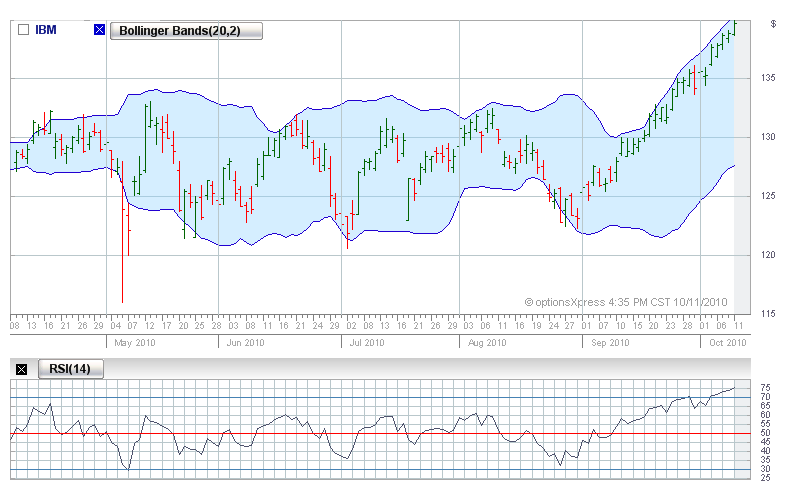
$IBM finishes at an all time high
Here's a message I tweeted on Twitter back in September about Big Blue:
I remain bullish on $IBM. A friend who works there is as grim as ever about staff and other cuts. $140 is an easy call by Christmas.
By Christmas? It's taken far less time for it to rise about $10 since I mentioned it. IBM finished at 139.66 today.
Now the stock is extremely overbought. Consolidation time at the very least. Watch out for a pullback if the overall market heads south.

It's not just Food that's going to jump
what about shipping and the DOT regs? Here's a quick message from a friend for you to consider:
"Add another factor in: my husband and I recently talked to the driver of the truck which transported our stuff to the West Coast (owns his own truck, has done this for decades, knows the industry well.) He said with regulations implement...ed by DOT at the start of this year, transport costs for goods are going to skyrocket in the coming months. The changes are designed to protect drivers from fatigue, but they include limits on how many hours drivers can work/drive per day. That will lead to longer delivery times & added expenses which get passed on to consumers."
"Add another factor in: my husband and I recently talked to the driver of the truck which transported our stuff to the West Coast (owns his own truck, has done this for decades, knows the industry well.) He said with regulations implement...ed by DOT at the start of this year, transport costs for goods are going to skyrocket in the coming months. The changes are designed to protect drivers from fatigue, but they include limits on how many hours drivers can work/drive per day. That will lead to longer delivery times & added expenses which get passed on to consumers."
The Titles, $POT $AAPL $CORN
As mentioned, I still see the title insurance companies as good short plays.
Things will eventually resume in the mortgage world but it may take a
while, invalidating their business models. What will they do in the
meantime? Make oven mitts?? Tickers include: $LPS $ASPS $FNF $FAF $ORI .
AS usual this is not official financial advice. Do your own due diligence.
$BAC and $WFC look like the ugliest banks in a foreclosure freeze. I blog
more about the banking mess here:
$POT
Potash shares are coming back to life as it is now threatening a breakup
and huge dividend payment. The train is about to leave the station again.
TelegraphNews Potash plans break-up to foil Billiton bid http://bit.ly/b8pxze $POT
$AAPL whisper rev number for 3rd qtr is $20 bln. As long as market holds up
on QE spec, Apple looks like a fairly good short term bullish scalp up thru
earnings. Yes, it is priced to perfection and yes they can be very
conservative in the guidance.
The $CORN etf will fly higher again. CORN CROP ESTIMATE CUT 3.8% --BIGGEST CUT IN 36 YEARS--ADVERSE WEATHER TRIMS YIELDS-- ALL GRAINS LIMIT UP $$
Things will eventually resume in the mortgage world but it may take a
while, invalidating their business models. What will they do in the
meantime? Make oven mitts?? Tickers include: $LPS $ASPS $FNF $FAF $ORI .
AS usual this is not official financial advice. Do your own due diligence.
$BAC and $WFC look like the ugliest banks in a foreclosure freeze. I blog
more about the banking mess here:
$POT
Potash shares are coming back to life as it is now threatening a breakup
and huge dividend payment. The train is about to leave the station again.
TelegraphNews
$AAPL whisper rev number for 3rd qtr is $20 bln. As long as market holds up
on QE spec, Apple looks like a fairly good short term bullish scalp up thru
earnings. Yes, it is priced to perfection and yes they can be very
conservative in the guidance.
Sunday, October 10, 2010
The tin ear of the Obama administration
A blanket freeze on foreclosures IS coming but at the hands of state attorneys general and market forces. Axelrod and his boss are irrelevant as they had put their full faith and trust in banks to do the right thing. For over a year through meaningless federal programs like the now infamously ineffective HAMP, the problems of the mortgage industry have been allowed to fester. We now know that banks had little reason to help distressed homeowners and in fact ran amok of standard due process, foreclosure proceedings. The foreclosure mess is exposing the failure of banks to have done correct paperwork and documentation on the securitization side of the equation. So now we're faced with a cloud of doubt over the validity of what were heretofore believed to be clear titles. This is an across the board mortgage (not just foreclosure) fiasco.
WASHINGTON — A top White House adviser questioned the need Sunday for a blanket stoppage of all home foreclosures, even as pressure grows on the Obama administration to do something about mounting evidence that banks have used inaccurate documents to evict homeowners.
"It is a serious problem," said David Axelrod, who contended that the flawed paperwork is hurting the nation's housing market as well as lending institutions. But he added, "I'm not sure about a national moratorium because there are in fact valid foreclosures that probably should go forward" because their documents are accurate.
Axelrod said the administration is pressing lenders to accelerate their reviews of foreclosures to determine which ones have flawed documentation.
"Our hope is this moves rapidly and that this gets unwound very, very quickly," he said.
With the reeling economy already the top issue on voters' minds, the doubts raised over foreclosures and evictions are becoming a political issue with the approach of Nov. 2 elections.
Underscoring those pressures, two leading lawmakers took opposing stances on the wisdom of a moratorium.
Rep. Debbie Wasserman Schultz, D-Fla., a top House Democrat, said she backed a foreclosure moratorium and government talks with the banking industry to concoct ways to let lenders reshape troubled mortgages. She said the foreclosure problem has been "extremely vexing" in her state.
The No. 2 House Republican, Rep. Eric Cantor of Virginia, said a national moratorium would remove the protections that lenders need.
"You're going to shut down the housing industry" with a national stoppage, Cantor said. "People have to take responsibility for themselves."
In recent days, Senate Majority Leader Harry Reid, D-Nev., in a tough re-election race, urged five large mortgage lenders to suspend foreclosures in his state until they establish ways to make sure homeowners don't lose their homes improperly. Attorney General Eric Holder said that the government is looking into the matter, and Democratic lawmakers urged bank regulators and the Justice Department to probe whether mortgage companies violated laws in handling foreclosures.
The attorneys general of up to 40 states plan to shortly announce a joint investigation into banks' use of flawed foreclosure paperwork, a person familiar with the investigation told The Associated Press late Saturday.
On Friday, Bank of America became the first bank to halt foreclosures in all 50 states. Three other institutions — JPMorgan Chase & Co., Ally Bank's GMAC Mortgage unit and PNC Financial — have stopped foreclosures in the 23 states where foreclosures must be approved by a judge.
President Barack Obama vetoed a bill last week that would have made it easier for banks to approve foreclosure documents, which the White House said could hurt consumers.
Axelrod spoke on CBS' "Face the Nation" while Wasserman Schultz and Cantor appeared on "Fox News Sunday."
Friday, October 8, 2010
Why Dow 11k matters
Tonight on every t.v. newscast across the country, Dow 11,000 will get a mention. The tens of millions of average people who are not traders or market wonks care little about what other indicators like the S&P and Nasdaq are doing from day to day. Each night they hear about the Dow on the so called local t.v. "market report' and its good enough for them. 11k for the average person is a milestone number and most will simply conclude, perhaps with a little cheer, that at least their hard hit 401k's are not falling further.
My cynical side would add that a Dow 11k headline is a good way to smokescreen the lousy employment report and the snowballing banking foreclosure problem. Yes, the Dow matters and it matters quite a bit.
My cynical side would add that a Dow 11k headline is a good way to smokescreen the lousy employment report and the snowballing banking foreclosure problem. Yes, the Dow matters and it matters quite a bit.
Simple explanation of today's market action
lousy jobs report - sparks further economy worries - enough to convince investors FED will resort to another round of Quantitative Easing - so stocks rise - bond mkt fairly flat - gold gains as more expected QE means more mass printing of paper dollars. It's that simple.
One day it will all end badly for stocks and bonds. For now, however, I remain somewhat bullish on stocks as long as QE pumping is in the cards and the banks don't quickly implode over the foreclosure mess. One of the hard lessons in all of this: it's pretty easy to inflate the stock market, but not so easy to rejuvenate the economy. QE just doesn't seem to have a trickle down effect on the masses. QE feeds the banksters who get freed from government paper and other worthless assets. The banks then throw some money at the stock market and up it goes. That's essence of what's going on (in very simple terms).
One day it will all end badly for stocks and bonds. For now, however, I remain somewhat bullish on stocks as long as QE pumping is in the cards and the banks don't quickly implode over the foreclosure mess. One of the hard lessons in all of this: it's pretty easy to inflate the stock market, but not so easy to rejuvenate the economy. QE just doesn't seem to have a trickle down effect on the masses. QE feeds the banksters who get freed from government paper and other worthless assets. The banks then throw some money at the stock market and up it goes. That's essence of what's going on (in very simple terms).
Banks Already up to their usual tricks
The banking industry is already trying to use tactics to scare Congress into believing that a nationwide foreclosure timeout would be bad. Let's just forget about due process and let the banks do as they please even if it means technically breaking the law? That's a bad idea as well. Yes, I realize that deserved foreclosure occurs when the home-debtor decides to no longer make timely monthly payments. I still, however, have problems with banks that fail to provide accurate proof of ownership and complete paperwork to the courts. Here's the industry's dribble.
Letter From Banks to Congress on Risks of Foreclosures
Letter From Banks to Congress on Risks of Foreclosures
'This is the biggest fraud in the history of the capital markets'
Even the Washington Post knows there is big trouble ahead for the Banksters. Ezra Klein interviews Janet Tavakoli
Janet Tavakoli is the founder and president of Tavakoli Structured Finance Inc. She sounded some of the earliest warnings on the structured finance market, leading the University of Chicago to profile her as a "Structured Success," and Business Week to call her "The Cassandra of Credit Derivatives." We spoke this afternoon about the turmoil in the housing market, and an edited transcript of our conversation follows.
Ezra Klein: What’s happening here? Why are we suddenly faced with a crisis that wasn’t apparent two weeks ago?
Janet Tavakoli: This is the biggest fraud in the history of the capital markets. And it’s not something that happened last week. It happened when these loans were originated, in some cases years ago. Loans have representations and warranties that have to be met. In the past, you had a certain period of time, 60 to 90 days, where you sort through these loans and, if they’re bad, you kick them back. If the documentation wasn’t correct, you’d kick it back. If you found the incomes of the buyers had been overstated, or the houses had been appraised at twice their worth, you’d kick it back. But that didn’t happen here. And it turned out there were loan files that were missing required documentation. Part of putting the deal together is that the securitization professional, and in this case that’s banks like Goldman Sachs and JP Morgan, has to watch for this stuff. It’s called perfecting the security, and it’s not optional.
EK: And how much danger are the banks themselves in?
JT: When we had the financial crisis, the first thing the banks did was run to Congress and ask for accounting relief. They asked to be able to avoid pricing this stuff at the price where people would buy them. So no one can tell you the size of the hole in these balance sheets. We’ve thrown a lot of money at it. TARP was just the tip of the iceberg. We’ve given them guarantees on debts, low-cost funding from the Fed. But a lot of these mortgages just cannot be saved. Had we acknowledged this problem in 2005, we could’ve cleaned it up for a few hundred billion dollars. But we didn’t. Banks were lying and committing fraud, and our regulators were covering them and so a bad problem has become a hellacious one.
EK: My understanding is that this now pits the banks against the investors they sold these products too. The investors are going to court to argue that the products were flawed and the banks need to take them back.
JT: Many investors now are waking up to the fact that they were defrauded. Even sophisticated investors. If you did your due diligence but material information was withheld, you can recover. It’ll be a case-by-by-case basis.
EK: Given that our financial system is still fragile, isn’t that a disaster for the economy? Will credit freeze again?
JT: I disagree. In order to make the financial system healthy, we need to recognize the extent of our losses and begin facing the fraud. Then the market will be trustworthy again and people will start to participate.
EK: It sounds almost like you’re saying we still need to go through the end of our financial crisis.
JT: Yes, but I wouldn’t say crisis. This can be done with a resolution trust corporation, the way we cleaned up the S&Ls. The system got back on its feet faster because we grappled with the problems. The shareholders would be wiped out and the debt holders would have to take a discount on their debt and they’d get a debt-for-equity swap. Instead we poured TARP money into a pit and meanwhile the banks are paying huge bonuses to some people who should be made accountable for fraud. The financial crisis was a product of our irrational reaction, which protected crony capitalism rather than capitalism. In capitalism, the shareholders who took the risk would be wiped out and the debt holders would take a discount but banking would go on.
Bank of America halts its foreclosures
BAC and other big banking stocks are lower on a day when the Dow tops 11k (again).
WASHINGTON (AP) — A mushrooming crisis over potential flaws in foreclosure documents is threatening to throw the real estate industry into chaos, as Bank of America on Friday became the first bank to stop taking back tens of thousands of foreclosed homes in all 50 states.
The move, along with another decision on foreclosures by PNC Financial Services Inc., adds to growing concerns that mortgage lenders have been evicting homeowners using flawed court papers.
Charlotte, N.C.-based Bank of America Corp., the nation's largest bank, said Friday it would no longer complete foreclosures in all 50 states as it reviews documents used to process foreclosures. That applies to homes that the bank takes back itself and those that it transfers to investors such as mortgage giants Fannie Mae and Freddie Mac.
A week earlier, the company had said it would only do so in the 23 states where foreclosures must be approved by a judge.
The bank did so in reaction to mounting pressure from public officials inquiring about the accuracy of foreclosure documents. A company spokesman, Dan Frahm, said the bank still believes its documents are correct but wants to satisfy officials' concerns.
"Our ongoing assessment shows the basis for our past foreclosure decisions is accurate," he said.
Banking and housing analysts, meanwhile, fear the foreclosure document problems could prolong the housing bust, and hundreds of thousands of inevitable foreclosures will be pushed off into some legal limbo for years.
"If you are looking at the key in this country to economic stability, it's the housing industry," said banking analyst Nancy Bush of NAB Research. "This is a huge mess that helps nothing."
State and federal officials have been ramping up pressure on the mortgage industry over worries about potential legal violations amid growing evidence that mortgage company employees or their lawyers signed documents in foreclosure cases without verifying the information in them. Also Friday, Sen. Christopher Dodd, D-Conn, the chairman of the Senate Banking Committee, said he would hold a hearing on the issue next month.
"American families should not have to worry about losing their homes to sloppy bureaucratic mismanagement or fraud," Dodd said. "Regulators at the federal, state, and local levels have a responsibility to uphold the law and protect consumers from unfair foreclosure, and lenders have a duty to not cut corners around the law."
A document obtained last week by the Associated Press showed a Bank of America official acknowledging in a legal proceeding that she signed thousands of foreclosure documents a month and typically didn't read them. The official, Renee Hertzler, said in a February deposition that she signed 7,000 to 8,000 foreclosure documents a month.
Earlier in the week, Senate Majority Leader Harry Reid, D-Nev., urged five large mortgage lenders to suspend foreclosures in Nevada until they have set up systems to make sure homeowners aren't "improperly directed into foreclosure proceedings." Nevada is not among the states where banks had suspended foreclosures.
Also Friday, PNC Financial Services Group Inc. said it is halting most foreclosures and evictions in 23 states for a month so it can review whether documents it submitted to courts complied with state laws. An official at the Pittsburgh-based bank confirmed the decision on Friday, which was reported earlier by the New York Times. The official requested anonymity because the decision hasn't been publicly announced.
PNC becomes the fourth major U.S. lender to halt some foreclosures amid evidence that mortgage company employees or their lawyers signed documents in foreclosure cases without verifying the information in them.
In addition to PNC and Bank of America, Ally Financial's GMAC Mortgage unit and JPMorgan Chase & Co. have announced similar moves in the past two weeks.
In some states, lenders can foreclose quickly on delinquent mortgage borrowers. By contrast, the 23 states use a lengthy court process. They require documents to verify information on the mortgage, including who owns it.
Subscribe to:
Posts (Atom)